
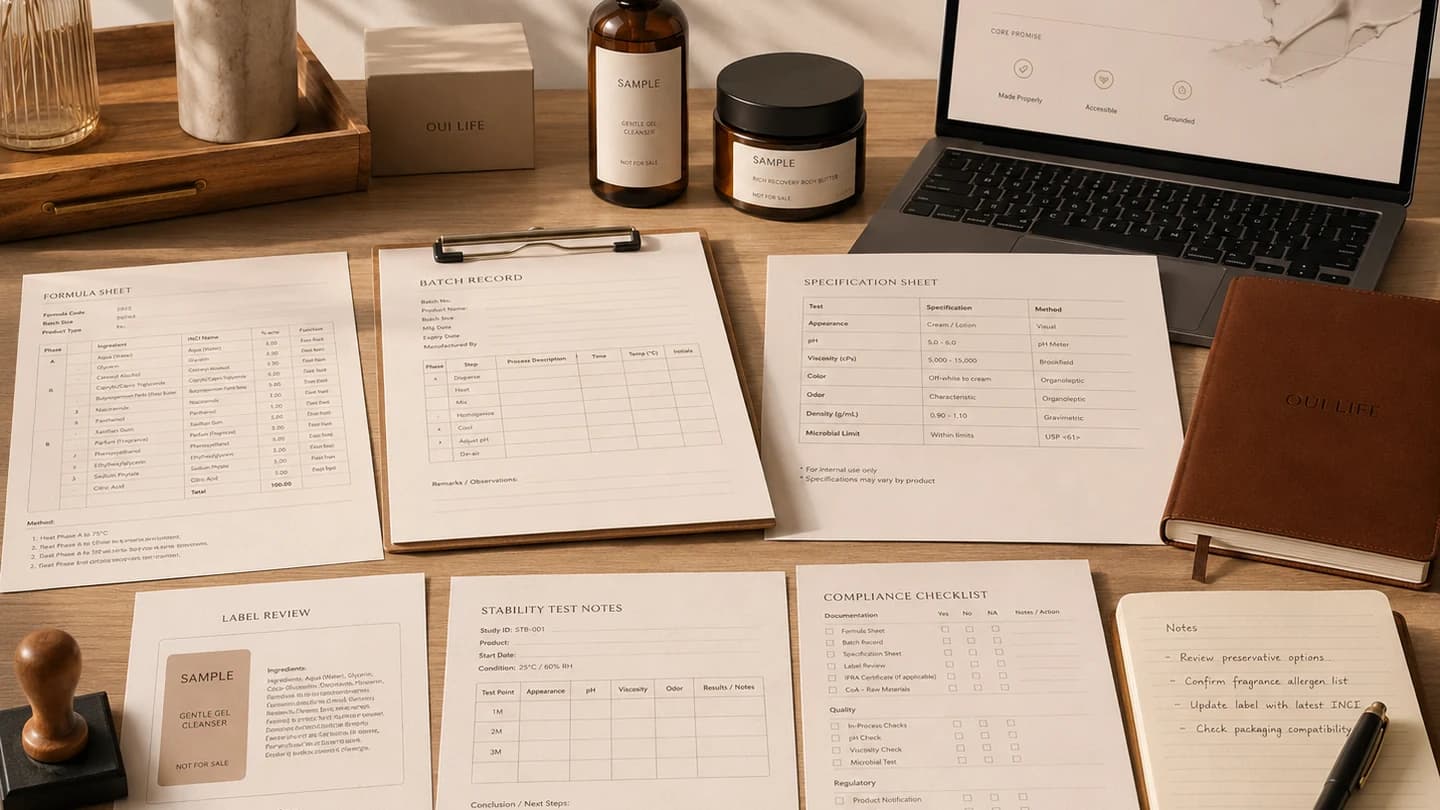
Retailers and regulators do not assess your product by using it. They assess the records that describe it. A formula that performs beautifully and cannot be documented is, commercially, an unfinished product.
Here is what each record actually does, in the order a project tends to need them.
Label input document
The label input document is the formatted source of truth for everything that must legally and practically appear on pack: ingredient declaration, volume, batch identification, usage direction and responsible-party details.
Your designer works from it. Without it, artwork gets built from a marketing brief and then corrected against a regulatory requirement — usually after a print quotation has already been approved. It is included on every OUI route.
INCI ingredient list
The INCI list names every ingredient using the International Nomenclature of Cosmetic Ingredients — the standardised naming system regulators and retailers expect, in descending order of concentration within the conventions that apply.
It matters beyond compliance: it is how a consumer with an allergy, a retailer's compliance team and an overseas distributor all read the same product the same way. Included on every route.
Product specification sheet
The specification records what the product must be for a batch to be acceptable — appearance, colour, odour, pH range where relevant, viscosity range and the other physical parameters that define the product.
This is the document that makes repeat manufacture meaningful. Without an agreed specification, "the same as last time" is an opinion rather than a standard. Included on every route.
SDS/MSDS
A safety data sheet describes handling, storage and transport considerations. Logistics providers, warehouses and some retailers request it before they will accept stock, and it is frequently needed for export shipments.
At OUI it is included where applicable on semi-custom and custom routes, and available separately where a private-label project requires it.
Packaging compatibility review
Compatibility review checks that the formula and its final agreed container behave acceptably together across the required testing window — no separation, discolouration, scent change or material interaction that would surface after the product reaches a shelf.
It is scoped to the final agreed packaging supplied within that window. This is the practical reason packaging is confirmed before formulation rather than after.
Stability and compatibility testing
Stability work observes how a formula behaves over time and under varied conditions, which is what supports any shelf-life statement you intend to make.
It is included on the custom route, where a new formula has no track record, and available separately on private label and semi-custom, where the base has established behaviour.
NAFDAC-readiness documentation
NAFDAC readiness means arriving at registration with a complete, coherent document pack rather than assembling it under time pressure. OUI prepares the route-scoped product and formula documentation and supports readiness once the formula is finalised.
One boundary worth stating plainly: registration filing, third-party costs and submission responsibilities are confirmed separately. Readiness is documentation work; registration is a regulatory process with its own timeline, and NAFDAC assesses on its own terms.
CPSR-ready records for UK/EU
If you intend to sell into the UK or EU, a Cosmetic Product Safety Report is part of what those markets require, along with Responsible Person arrangements.
OUI prepares CPSR-ready records — the formulation, specification and supporting data a safety assessor needs — and coordinates with an appointed Responsible Person where that is included in the project scope. It is available separately on semi-custom and custom routes.
The order that actually works
- Confirm packaging, then formulate — compatibility and label space both depend on it.
- Finalise the formula, then generate the label input document and INCI list.
- Agree the specification before your first production run, not after your second.
- Scope testing and market documentation against the market you are actually entering first.
Every OUI route names its documentation package upfront, so what you receive is a stated scope rather than an assumption. If your market needs something outside that scope, it is quoted separately and confirmed in writing — which is a slower conversation to have at brief stage and a much cheaper one than having it at customs.